site.btaMedia Review: September 3
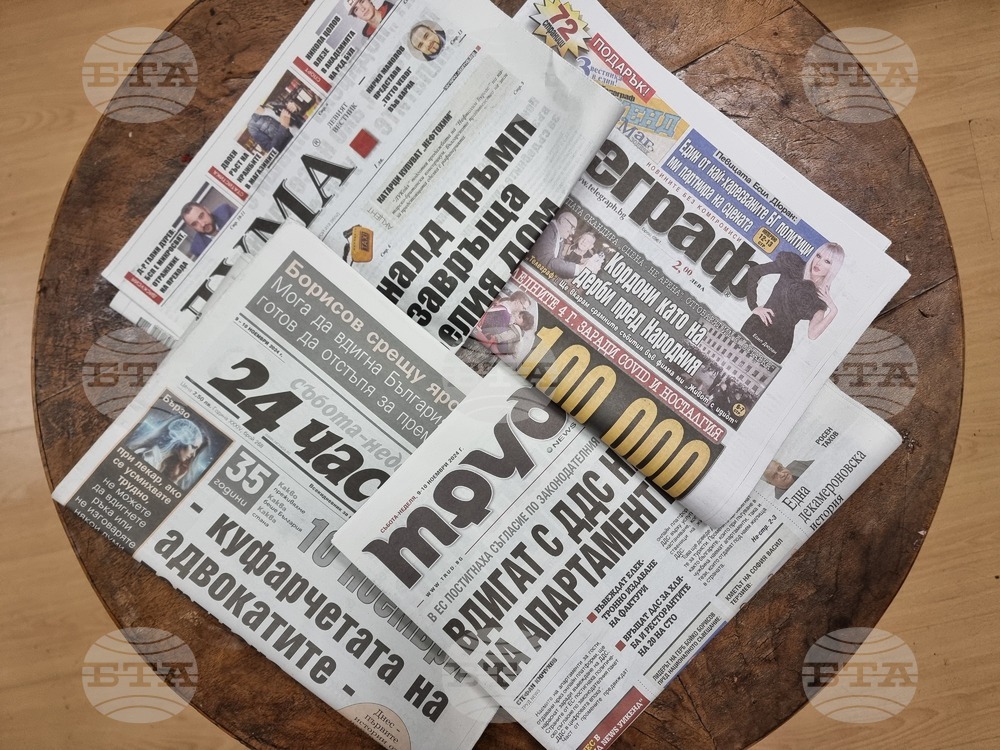
PRESIDENTIAL ELECTION
Media outlets discuss at length the October 25 presidential election.
Interviewed by Bulgarian National Television (BNT), presidential candidate Andrey Gurov said he owed services to no one, stressing that his only responsibility was to Bulgarian citizens. He said he had many friends in Continue the Change and was relying on them, as well as on all other Bulgarian citizens, adding that he believed presidential elections should not be based on party nominations. Gurov said he had never dreamed of becoming president, describing the office as a responsibility rather than a dream. He said he was entering the race to win.
***
Nova TV rounded a panel of analysts to comment on the chances of victory of the presidential tickets.
Sociologist Kancho Stoychev said GERB faced a choice over whether to field a candidate, as its supporters would naturally want the party to have its own contender. The main intrigue of the election lies with the opposition, which is in a crisis and needs to restructure, renew itself and survive. Stoychev also said that if journalist Petar Volgin, now an MEP from Europe of Sovereign Nations, were nominated by Vazrazhdane, he could become a "lightning rod" for radical voters, adding that a strong candidate in the radical political spectrum always has potential.
PR expert Diana Damyanova said the presidential race remained unclear until it was known whether GERB would field a candidate. She said the already announced candidates were trying to distance themselves from party backing, while several explicitly party-backed candidates were also expected to run. The presidential election is unlikely to change Bulgaria's geopolitical course, but could give voters an opportunity to back a second strong political voice alongside the incumbent President Iliana Iotova, assuming she remains a loyal and full supporter of Rumen Radev. Damyanova said the election was in some respects already predetermined, with the main question becoming who would emerge as the alternative to Radev and his political camp in the months that followed.
Journalist Veselin Stoinev said the key question was whether the ruling majority would be reaffirmed through Iotova's candidacy or whether an opponent could mount a strong challenge in the second round. He noted that although presidential elections were designed to be majoritarian, the first round was effectively partisan. Stoinev also said that if Vazrazhdane nominated Petar Volgin, he could pose a stronger challenge to both Iotova and Andrey Gurov, potentially drawing voters from Progressive Bulgaria and from opposition-minded voters outside the traditional democratic community. At the same time, Volgin does not have a strong presidential profile and could disrupt the expected "gentlemanly" contest between Iotova and Gurov.
REACTIONS TO DRONE ATTACK IN GERMANY
A drone carrying explosives was found and defused at Leipzig's civilian airport on August 4 near a Ukrainian Antonov cargo aircraft, briefly disrupting flights. A second drone later collided with an aircraft near the airport, a major cargo hub in eastern Germany. German Interior Minister Alexander Dobrindt said police investigations, the pattern of the attack and intelligence pointed to Russian responsibility, describing it as part of a familiar Russian hybrid-operation pattern in Europe. Russia rejected the accusation.
24 Chasa reports that Bulgaria expressed solidarity with Germany and said hybrid attacks against partners and allies were unacceptable, but the Foreign Ministry stopped short of naming Russia. The opposition criticized the government for failing to take a clear position, with GERB, Continue the Change and Democratic Bulgaria calling for President Iliana Iotova to convene the Consultative Council for National Security. Petar Vitanov, Floor Leader of the ruling Progressive Bulgaria, defended the government's cautious approach, saying Bulgaria should wait for the conclusion of the German investigation before assigning responsibility to Russia. He argued that the Russian link remained only a suspicion and that initial allegations had previously differed from later findings, citing Nord Stream.
***
On Nova TV, national security expert Ivan Anchev and journalist Asen Genov commented that Russia is stepping up its hybrid attacks against Europe. Anchev said the Leipzig/Halle airport attack should be attributed to Russia or its agents, based on the German authorities' statements. He said the strategic aim of such actions was to divide European societies. He criticized Bulgaria for failing to take a clear position and called for a response in line with its EU and NATO allies.
Genov described the Leipzig/Halle incident as an action verging an open military conflict, saying hybrid attacks were increasingly taking the form of sabotage targeting key logistical centres. He also criticized Bulgaria's response, saying the Foreign Ministry's statement failed to identify the perpetrator of the attack. He also pointed to Germany's recognition that the Russian Cultural Centre in Berlin served purposes beyond cultural exchange and its subsequent closure over links to subversive activity.
DEFENCE
In a BNT interview, Air Force Commander Maj. Gen. Nikolay Rusev said Bulgaria will have 11 trained F-16 pilots by the end of 2026 and 15 by April 2027. Saying that one fighter squadron is insufficient for Bulgaria as even the smallest Western European countries have dozens of fighter jets, he advocated having two squadrons operating two different aircraft types to ensure airspace protection if one type were grounded. Whether the second squadron will also consist of F-16s will be decided at the political level, he said. The delivery of Bulgaria's second batch of F-16 fighter jets is expected to be delayed until mid-2030, Rusev said, attributing the delay to the manufacturer having "slightly overestimated its capabilities" amid a large number of orders.
ECONOMY
Macroeconomist Stoyan Panchev says in Trud that higher teacher pay shows how labour shortages can be addressed. The increase in teacher salaries has helped attract younger people to the profession. The same principle could address shortages of nurses, doctors and workers in other sectors, saying that "there is nobody to work" often means there is nobody willing to do the job for the wages being offered.
***
Mediapool.bg says the Rumen Radev government is seeking to strengthen its partnership with China. To this end, the Council of Ministers approved four memorandums on economic and investment cooperation with Beijing on Wednesday.
On the same subject, segabg.com quotes economist Evgeni Kanev as saying that Radev's government was pursuing an intensive policy of attracting Chinese investment and could seek Chinese investors to build roads in Bulgaria under concession arrangements. He said this was causing concern in the construction sector, as Chinese companies tended to negotiate directly with governments rather than compete in tenders. Kanev also warned that using large amounts of public money for such infrastructure projects, rather than relying solely on private capital, carried a significant corruption risk.
Reportedly, Deputy Prime Minister Alexander Poulev is preparing to visit China with a delegation, where a number of investment agreements are expected to be signed.
***
Interviewed by bTV, Energy Minister Iva Petrova said Unit 5 of Kozloduy NPP was gradually returning to full capacity after critically low Danube levels posed serious challenges to the plant's operation. She said electricity exports had not been reduced and Bulgaria's strong interconnection with neighbouring countries had enabled it to support the region.
Petrova also said a new holding company, Maritsa East Holding, had been established, bringing together Maritsa East Mines and Maritsa East 2 TPP as part of the reform of the complex. The aim is to stabilize and restructure the companies, reduce their operating costs and emissions, and gradually address their debts, with investments planned in projects including biomass use and solar power with batteries.
Asked about electricity prices, Petrova said market volatility was being observed but there were sufficient generation capacities and energy in the region. She said compensation mechanisms were in place to shield household consumers from major price fluctuations, as well as measures to support non-household consumers, including energy-intensive industries.
LIFESTYLE
24 Chasa and Trud lead with health-related topics. 24 Chasa explains a new eHealth transparency mechanism that will let patients see what the National Health Insurance Fund (NHIF) has paid for on their behalf, quickly flag fraudulent or incorrect claims, and receive the findings of the subsequent check. Information about examinations, tests, vaccinations and treatment will be stored in the patient's electronic health record. The system has already generated around 1,760 citizen reports and 560 checks, with the largest number coming from Sofia, Plovdiv, Varna and Burgas. The app now has about 450,000 users, with usage quadrupling after a promotional campaign. Five NHIF contracts have already been terminated following citizen reports, with further sanctions expected.
Trud and bTV sound the alarm that Bulgarians tend to buy heavily advertised "health" products. In a bTV interview, Bulgarian Drug Agency Executive Director Bogdan Kirilov said that illegal and unapproved medicines and products of unproven efficacy are increasingly being offered online, particularly through websites and social media. He described the scale of the problem as serious, noting that 85,000 slimming patches were recently seized in Varna during an attempted illegal import. Kirilov said the agency was increasingly identifying unlicensed medicines sold online. An administrative offence procedure has been launched against a company in one such case, with a potential fine of nearly EUR 38,000. He stressed that slimming medicines should only be used following a medical examination and obtained from a pharmacy against an e-prescription and after the required tests.
Desislava Vlasakieva, organizer of the Health Without Risk campaign, said illegal health products amounted to a "modern pandemic". Citing Research Centre Trend's survey, she said one in three Bulgarians had made a health decision influenced by advertising or the internet, while four in 10 had taken products on the recommendation of a non-medical person.
On an inside page, Trud says the NHIF plans 10% higher payments for clinical pathways under the new National Framework Agreement.
***
In a Trud interview, Bogomil Nikolov, Executive Director of the Active Consumers Association, talks about counterfeit food products, among other things. Olive oil is the most counterfeited food product in the world, but Bulgaria lacks sufficient capacity to detect it, although cases are uncovered from time to time. Counterfeit olive oil may simply be ordinary vegetable oil mixed with colouring agents. In one case, more than 27,000 bottles were withdrawn from the market after it was found that a product marketed under a popular brand contained only 20% olive oil, while the remaining 80% was ordinary vegetable oil. As to white brined cheese, five of 12 cheese products tested by the Active Consumers Association, or 42%, had high water content, with some containing as much as 70%. Under the regulations, the maximum water content for unpackaged cheese is 65%. The high water content indicates that the cheese has not undergone the required 45-day maturation period. The products, which were found in major retail chains participating in the government's Care Basket initiative, were priced at between EUR 5 and EUR 6 per kilogramme, compared with an estimated EUR 9 per kg for good-quality cheese. Active Consumers found no quality issues in butter sold in retail chains, but counterfeit butter, actually margarine, remains a risk in food-service establishments, including hotels, hospitals and schools.
***
Psychotherapist Sirma Georgieva told Bulgarian National Radio that a proposal to allow State Agency for National Security (SANS) employees to practise psychotherapy is raising concerns. The proposal is part of amendments to the SANS Act currently open for public consultation. She warned that this could undermine clients' trust and create a conflict between therapists' professional duties and their responsibilities as security service employees. She said clients might hesitate to share sensitive information if they knew their therapist worked for SANS. The proposed amendment does not require patients to be informed whether their therapist is a SANS employee. Georgieva stressed that trust is built through interpersonal relationships rather than legal frameworks, and that the therapy room must be a highly protected space where clients feel safe enough to speak openly about their most vulnerable experiences.
***
Duma reports that beaches along Bulgaria's southern Black Sea coast are offering lower prices for umbrellas and sun loungers in early September as part of efforts to extend the active summer season beyond August. Umbrella and sun lounger sets at Sunny Beach's Central Beach are reduced from EUR 16 to EUR 10 and in Ravda from EUR 20 to EUR 15. With seawater temperatures still around 25C, conditions remain favourable for beachgoers, said Simeon Tsvetkov, Chairman of the Association for the Development of Sea Beach Management Activities. Early September comes with calmer sea and less wind than in August. Beaches will have full lifeguard coverage until September 15.
/DD/
news.modal.header
news.modal.text