site.btaMedia Review: June 11
HEADLINES
The leading topics in Bulgaria's print and online media on Thursday are the government's consumer basket initiative, presented as a measure to address rising prices and broader economic policy, the decision to suspend further military assistance to Ukraine, and the results of this year's national examinations for seventh- and twelfth-grade students, which have prompted renewed discussion about educational standards and student performance.
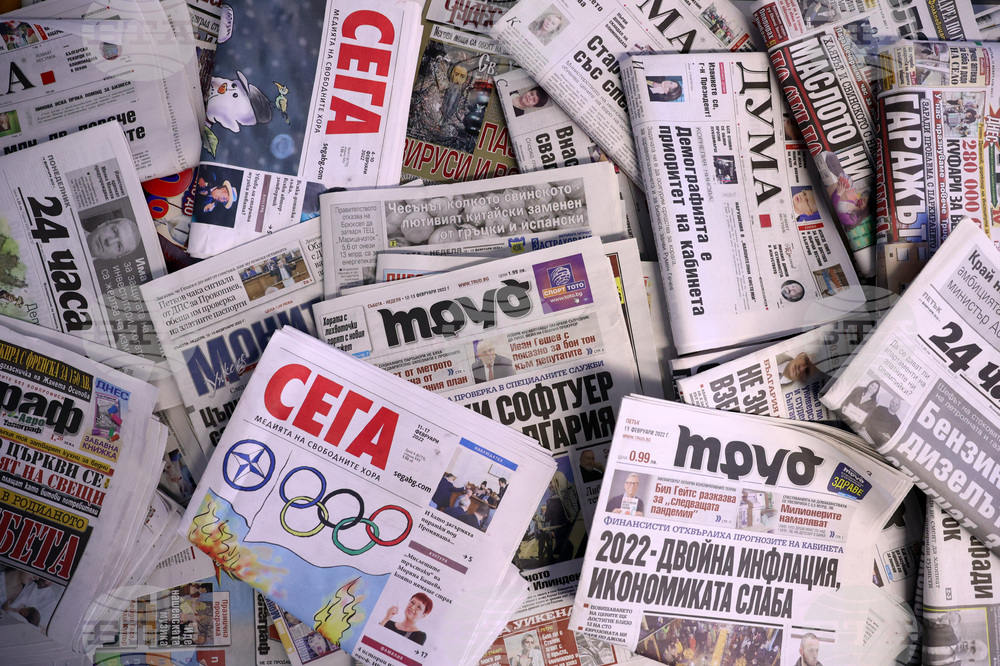
Print media lead on Thursday with domestic political and economic issues. 24 Chasa reports on parliament's decision to freeze MPs' salaries, while noting that lawmakers will continue to receive additional remuneration and allowances. Trud focuses on Bulgaria's military assistance to Ukraine, examining the scope of equipment and support provided to Kyiv. Telegraph highlights alleged practices in the real estate market that artificially inflate property prices through so-called "support properties" used in transactions.
Among the leading interviews, 24 Chasa features former labour and social policy minister Ivaylo Kalfin, who argues that pensions should be linked solely to social security contributions, while other payments should be treated as social assistance. In Trud, entomologist Valeri Velev discusses the growing risks posed by ticks and warns against using alcohol, oil or cream before removing them. Telegraph interviews Syndicate of Bulgarian Teachers Chair Yanka Takeva, who advocates introducing a formula linking teachers' remuneration to educational outcomes and performance.
MILITARY AID TO UKRAINE
The government's decision to discontinue military aid to Ukraine remained among the leading topics in the media landscape. Speaking on Bulgarian National Television, MEP Emil Radev (GERB/EPP) said Bulgaria is no longer providing military equipment free of charge, having already completed the previously approved assistance packages. He stressed, however, that Bulgarian defence companies continue to manufacture and sell arms to Ukraine through commercial contracts, either directly or via intermediaries. Radev argued that recent statements about halting aid had created confusion among Bulgaria's European partners and called for greater clarity regarding the distinction between military donations and commercial arms exports.
The issue was also discussed in bTV's morning programme, where commentators offered differing interpretations of the government's announcement. Journalist Assen Agov described the statement as largely symbolic, arguing that Bulgaria had already exhausted the military equipment it could provide from its own stocks and that the country had never supplied aid at its own expense. Political scientist Maria Pirogova said the move mainly signalled an end to transfers from Bulgarian Army inventories, while arms exports by domestic manufacturers would continue. Former energy minister Miroslav Sevlievski argued that continued support for Ukraine remained important for European security, warning that a Russian victory would have broader geopolitical consequences for the region.
The topic was also examined by 24 Chasa, which reported that the government's decision concerns only the free transfer of equipment from Bulgarian Army stocks and does not affect commercial arms exports. The newspaper noted that Defence Minister Dimitar Stoyanov had said Bulgaria had already exhausted its capacity to provide additional military assistance from army inventories and that Kyiv had not submitted further requests. At the same time, 24 Chasa highlighted mixed financial results in the defence industry. While arms trader Kintex reported higher revenues and profits, major producers such as VMZ-Sopot and NITI registered declining sales and earnings in the first quarter of 2026 compared with a year earlier, reflecting changing market conditions and shifts in demand within the defence sector.
Trud approaches the issue primarily through the government's perspective, highlighting Prime Minister Rumen Radev's statement that Bulgaria is ending the provision of weapons and ammunition from army stockpiles because the conflict cannot be resolved through military means. The newspaper gives prominence to the argument that efforts should focus on diplomacy and negotiations, while Defence Minister Dimitar Stoyanov is quoted as saying that Bulgaria has already delivered 13 military aid packages and no longer has the capacity to provide additional equipment from its own reserves. The report also stresses that commercial arms sales by Bulgarian defence companies to Ukraine will continue and that the decision does not alter Bulgaria's commitments within the EU and NATO.
Telegraph presents the issue primarily through the lens of political confrontation, describing the decision to halt military aid from Bulgarian Army stockpiles as a source of renewed tensions between the government and the opposition. The newspaper reports Prime Minister Rumen Radev's argument that Bulgaria has already provided sufficient assistance and should focus on diplomatic efforts to end the war, while also highlighting criticism from opposition parties. Representatives of GERB and Continue the Change-Democratic Bulgaria argue that support for Ukraine strengthens Bulgaria's strategic position and benefits the domestic defence industry, whereas Vazrazhdane calls for a complete ban on arms exports and re-exports to Ukraine. The report also notes assurances from Foreign Minister Velislava Petrova that any future assistance will be considered on a case-by-case basis through the established government and parliamentary procedures.
ECONOMY
The government's "Care Basket" initiative, aimed at lowering the prices of selected essential goods, continued to generate debate. In a discussion on bTV, representatives of the food industry expressed cautious support for the measure but warned against shifting the burden onto producers. Dimitar Zorov of the Association of Dairy Processors said the initiative had been presented as relying on lower retail markups rather than pressure on manufacturers, while calling for broader measures to improve market conditions and strengthen oversight of unfair trade practices. He also argued that some products included in the basket appeared to favour retailers' own brands, raising concerns about fair competition. Ivaylo Galabov of the Union of Poultry Breeders said he had not received reports of pressure on producers in his sector and stressed that lasting price stability could only be achieved through stronger competition. Both participants described the initiative as a temporary measure that could help ease concerns over rising prices and inflation while longer-term solutions are sought.
EDUCATION
Education remained among the prominent topics in the media following the publication of this year's matriculation exam results. In an interview for BNT, Deputy Education Minister Tanya Pancheva said the average score on the Bulgarian language and literature matriculation exam was the highest since the introduction of the current examination system in 2008. She noted that higher average scores had also been recorded across all 82 state matriculation examinations held this year. Pancheva described the results as evidence that the Education Ministry's long-term policies to improve the quality of education are producing positive outcomes. At the same time, she acknowledged that direct comparisons with previous years should be treated cautiously because different graduating classes sit different examinations. According to the deputy minister, the exam tasks corresponded to the school curriculum, while the essay topics selected this year were viewed favourably by many students and did not present unusual difficulties.
An analysis published by Dnevnik challenges official claims that this year's matriculation exam results represent a record achievement and a long-term improvement in educational outcomes. The article argues that direct comparisons between examination results from different years are methodologically flawed because each year's tests contain different questions and vary in difficulty. According to the analysis, internationally accepted assessment practices require statistical calibration and the use of common benchmark tasks to allow reliable comparisons over time. The author notes that no such methodology has been publicly presented for Bulgaria's matriculation or national external assessments, making it impossible to determine whether higher scores reflect improved student performance or simply differences in test design. The commentary therefore cautions against interpreting this year's results as evidence of a sustained upward trend in educational achievement.
In an interview for Telegraph, Bulgarian Teachers' Union Chair Yanka Takeva discussed education funding, teacher remuneration and possible future reforms. She said the union would seek additional resources for the education sector in the 2026 and 2027 budgets and would continue to insist that teachers' salaries remain linked to the statutory target of 125% of the national average gross wage, while acknowledging that fiscal pressures could make further increases difficult. Takeva argued that any attempt to tie teachers' pay directly to student performance would require objective criteria that have not yet been developed either in Bulgaria or internationally. She also called for more differentiated approaches in the classroom to address varying student abilities and suggested revisiting some aspects of the inclusion model for children with special educational needs. More broadly, Takeva defended the quality of Bulgaria's education system and teaching workforce, while stressing the need for continued investment in education as a long-term national priority.
The discussion about education and literacy also extended beyond exam scores into broader questions about culture and critical thinking. On its front page, 24 Chasa published a commentary arguing that exposure to literature, cinema and the humanities at a young age plays a crucial role in developing independent judgement later in life. Using a deliberately provocative tone, the author contends that reading writers such as George Orwell, Fyodor Dostoevsky and Joseph Heller, and engaging with influential films and cultural works during adolescence and early adulthood, helps build resistance to manipulation, populism and pseudoscientific trends. The article links declining reading habits to the growing popularity of self-help influencers, conspiracy theories and simplistic political narratives, reflecting wider concerns in Bulgarian public debate about media literacy, critical thinking and the role of education in contemporary society.
/YV/
news.modal.header
news.modal.text